


I blew my first betting bankroll in three weeks. Not because my picks were terrible — I was actually hitting at 53% on the moneyline — but because I was staking five times my normal amount on games I felt “certain” about and minimum amounts on everything else. Two bad “certainties” in a row wiped out weeks of steady profit. That crash course in bankroll destruction is why I now preach the flat-unit system with the fervour of a convert. It is the most boring, most reliable, and most undervalued skill in sports betting.
The Flat-Unit System
Tim Miller, executive director of the UK Gambling Commission, has been clear that there is a group of vulnerable customers not being identified by current approaches. Bankroll management is not just a strategy — it is a self-protection mechanism. The flat-unit system is the simplest version: pick a unit size, bet that amount on every single wager, and never deviate regardless of how confident you feel.
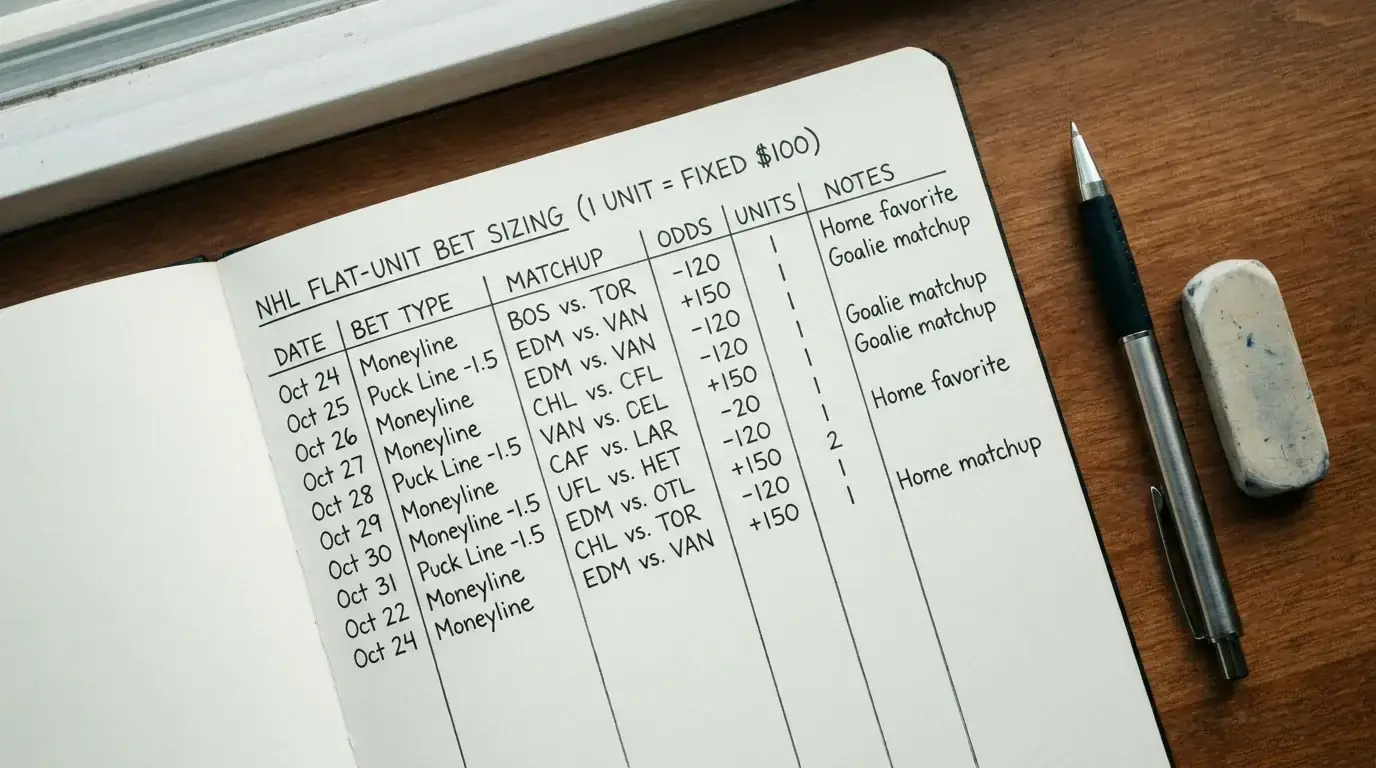
Your unit size should be 1-2% of your total bankroll. If you start the NHL season with a bankroll of 500 pounds, one unit is five to ten pounds. Every moneyline bet, every puck line play, every totals wager — five to ten pounds, the same amount, every time. The purpose is to survive losing streaks, which are inevitable. Even a bettor with a genuine 55% win rate will encounter stretches of eight to ten consecutive losses multiple times across an 82-game season. At 1% unit size, a ten-bet losing streak costs 10% of your bankroll. At 5% unit size, the same streak obliterates half your bank and forces you into a recovery hole that requires a 100% return just to break even.
The exception I allow is a half-unit play for lower-confidence bets and same game parlays. This is still flat — 0.5 units every time for that category — but it acknowledges that some bet types carry higher variance and deserve smaller exposure. I never go above one unit on any single bet. The moment you start sizing bets by confidence, you are introducing a subjective variable that your long-term data does not support.
ROI Tracking
You cannot manage what you do not measure. I track every NHL bet in a spreadsheet with the following columns: date, game, market, selection, odds, stake, result, profit or loss, and cumulative ROI. The cumulative ROI column is the heartbeat of my operation — it tells me at a glance whether my strategy is working or whether I am donating money to the bookmaker.

ROI calculation is simple: total profit divided by total amount staked, multiplied by 100. If you have staked 2,000 pounds across the season and your net profit is 140 pounds, your ROI is 7%. Legal sportsbooks in the United States processed over 165 billion dollars in handle during 2025 at a hold rate above 10% — meaning the average bettor lost 10% of everything wagered. An ROI of 5% or above in the NHL puts you comfortably in the top tier of recreational bettors, and anything above 8% over a full season is elite.
I review my ROI monthly, filtered by market type. If my moneyline ROI is positive but my puck line ROI is negative, I know to reduce puck line activity. If my home-underdog filter is producing +12% ROI but my road-favourite filter is at -4%, the data tells me exactly where to allocate more volume. Tracking is not optional — it is the mechanism that converts a betting strategy from a theoretical edge into a measurable, improvable system.

Seasonal Bankroll Cycle
The NHL season runs from October to June, with the regular season occupying October through mid-April and the playoffs stretching through June. That eight-month span creates a natural bankroll cycle that I structure my money around.

I set my bankroll at the start of October and do not add to it during the season. If I lose 30% by December, I reduce my unit size to 1% of the new, lower bankroll — not 1% of the original. This drawdown adjustment prevents the catastrophic scenario where a bad first half leads to desperate second-half betting. Starting in 2026-27, the schedule expands from 82 to 84 games, which means two extra weeks of regular-season action and a slightly longer cycle to manage.
The playoffs require a separate approach. Playoff hockey is more volatile than the regular season — fewer games, higher intensity, and goaltenders who can single-handedly carry a series. I reduce my unit size by half during the playoffs, effectively treating my post-season bankroll as a conservative sub-account. The reduced exposure protects me from the amplified variance while still allowing me to capitalise on the analytical edges that carry over from the regular season.
At the end of June, I close the books, calculate my season-long ROI, withdraw any profit above my starting bankroll, and reset for the following October. That withdrawal step is psychologically important: it converts paper gains into real money in my non-betting account, which reinforces the discipline of treating betting as a structured activity rather than a compulsive one.
Why Flat-Unit Beats the Alternatives
Plenty of bettors swear by variable staking — the Kelly Criterion, confidence-based scaling, proportional betting. I have tested all of them across multiple seasons and my conclusion is unambiguous: flat-unit staking delivers the best risk-adjusted returns for NHL bettors who are not operating with a team of quantitative analysts behind them.

The Kelly Criterion tells you to size your bet proportionally to your edge divided by the odds. The problem is that it requires you to know your true edge with precision, which you do not. Overestimating your edge by even 2% leads to aggressive oversizing that amplifies drawdowns. In a sport where 10% of UK adults are placing bets and the market efficiency is tightening every year, the edge for any individual bettor is slim. Kelly assumes you know that slim edge exactly; flat-unit staking assumes you do not, and that humility is rewarded over the long term.
The flat-unit system is not glamorous. It will not produce screenshots of massive single-bet payouts. What it will produce is a sustainable, trackable, and emotionally manageable relationship with NHL betting that compounds over seasons rather than collapsing after a bad week.
