


This guide is built around a single principle
I placed my first NHL wager in 2018 — a moneyline on the Vegas Golden Knights during their miracle expansion run — and lost. The bet was pure gut feeling, zero analysis, and exactly the kind of mistake I now spend my working life helping people avoid. Eight years of tracking goaltender metrics, modelling schedule fatigue, and stress-testing xG differentials against closing lines have taught me one thing above all else: the edge in hockey betting belongs to those willing to do the homework the market skips.
If you're reading this from somewhere in the UK, you're part of a growing but still underserved group. Around 10% of British adults place a sports bet in any given four-week period, yet hockey barely registers in the national conversation. That's actually an advantage. While football markets are picked clean by an army of sharp syndicates and algorithmic models, NHL lines at UK bookmakers carry inefficiencies that a disciplined punter can exploit — especially on goaltender matchups, back-to-back scheduling, and niche prop markets that receive minimal attention on this side of the Atlantic.
Hockey accounts for roughly 11% of the total sports betting handle in the United States, where the major sportsbooks deploy dedicated trading desks and real-time pricing engines. In the UK, most bookmakers treat ice hockey as a secondary offering, which means their lines often lag behind the sharper North American originators. That gap — between where the line opens in London and where it closes in Las Vegas — is where value lives.
This guide is built around a single principle: process over picks. I won't hand you a tip sheet and send you off. Instead, I'll walk you through the framework I use every day — how I evaluate betting markets, why I obsess over save percentages, where advanced analytics like Corsi and expected goals fit into the workflow, and what UK-specific regulations every responsible punter needs to understand. Whether you've never placed a hockey bet or you're looking to sharpen an existing approach, the data and strategies here are designed to give you repeatable structure rather than one-off guesses.
Let's get into it.

What Every UK Bettor Needs to Know About NHL Wagering
- Home underdogs are the NHL's most reliably mispriced spot — they covered the puck line in 63.9% of games and won outright 44.4% of the time during 2024-25, consistently outperforming their implied odds.
- Goaltender confirmation is non-negotiable before any bet. The league-wide save percentage has fallen to 89.6% in 2025-26 — the lowest in over 30 years — making the gap between starters and backups the single largest variable in game outcomes.
- Advanced analytics (Corsi, xG, Fenwick) are only useful if you have a workflow that converts data into a specific wagering decision. Pull a rolling fifteen-game window, compare to the bookmaker's implied probability, and only bet when the gap exceeds 3%.
- The CBA expires after this season. Avoid 2026-27 futures until labour negotiations produce clarity, and factor the expanded 84-game schedule into your models going forward.
- UK bettors operate under UKGC regulation: use licensed platforms, set deposit limits, and treat the flat-unit staking system as your baseline discipline rather than an optional extra.
NHL Betting Markets: What's on the Board and Where to Start
The first time I opened an NHL coupon at a UK bookmaker, I counted fourteen different markets for a single regular-season game between Minnesota and Columbus. Fourteen. For a sport that most British punters couldn't name five players in. That density of options is both an opportunity and a trap — because half those markets reward careful analysis, and the other half exist to extract money from casual bettors who don't know the difference between a puck line and a penalty kill. Let me break down the markets that matter.
Moneyline
Moneyline — a straight-up bet on which team will win the game, including overtime and the shootout. No point spreads, no margins. You pick the winner.
The moneyline is the purest hockey bet and the one I recommend every beginner starts with. In a typical NHL matchup, you'll see the favourite priced somewhere between 1.55 and 1.80 in decimal odds, with the underdog sitting between 2.10 and 2.60. The range is tighter than in basketball or American football because hockey outcomes are inherently volatile — a hot goalie or an early power-play goal can flip a game's trajectory in seconds. NHL underdogs won outright in 39.1% of games during the 2024-25 season, which is second only to baseball among North American professional leagues. That frequency keeps the moneyline interesting even when the talent gap between teams looks wide on paper.
Moneyline calculation example
Suppose Team A is priced at 1.65 (favourite) and Team B at 2.35 (underdog). A GBP 10 stake on Team A returns GBP 16.50 if they win. The implied probability of Team A winning at those odds is 1 / 1.65 = 60.6%. If your model suggests Team A actually wins 65% of the time in this spot, you've found a value moneyline.
Puck Line
Puck line — the NHL's version of a point spread, almost always fixed at -1.5 for the favourite and +1.5 for the underdog. Unlike football or basketball spreads, this number rarely moves.
The puck line is where patient bettors earn their keep. Because the spread is locked at 1.5 goals rather than
floating, the odds on either side do the adjusting. A heavy favourite might be -1.5 at 2.00 (evens), while the
same team's moneyline sits at 1.45. That shift in price is substantial — and it's backed by a statistical
reality. Underdogs covered the +1.5 puck line in approximately 60% of games during the 2024-25 season. Read
that again: six out of ten times, the dog either won outright or lost by exactly one goal.

For a full breakdown of when to choose the spread over a straight-up bet, I've written a dedicated piece on every wager type UK bookmakers offer for NHL hockey.
Puck line and overtime — Puck line bets include overtime and shootout results. If a game goes to a shootout, the winning team is credited with a one-goal victory, which means the favourite at -1.5 loses the puck line on a shootout win. This single rule catches more beginners than any other.
Totals
Totals (over/under) — a bet on the combined number of goals scored by both teams in a game. The most common line in the NHL is 6.5.
Totals betting in hockey is driven by goaltending, pace of play, and rest. The 6.5 line dominates the board, and in the 2025-26 season, overs have hit in 52.9% of games league-wide — a slight lean that reflects the ongoing rise in scoring. Totals reward bettors who track line-specific data rather than gut-feeling their way through "high-scoring" or "defensive" labels. I'll cover this in depth in the analytics section below.
Props, Futures, and Live Markets
Player props — shots on goal, points, saves, anytime goalscorer — have exploded across UK bookmakers in the last two seasons. Futures let you bet on the Stanley Cup winner, division champions, or individual awards months in advance. And live in-play markets create a dynamic pricing environment where the odds shift in real time as goals are scored, penalties called, and goaltenders pulled. Each of these markets has its own edge profile, and I cover the strategic approach to them in the cluster articles linked throughout this guide.
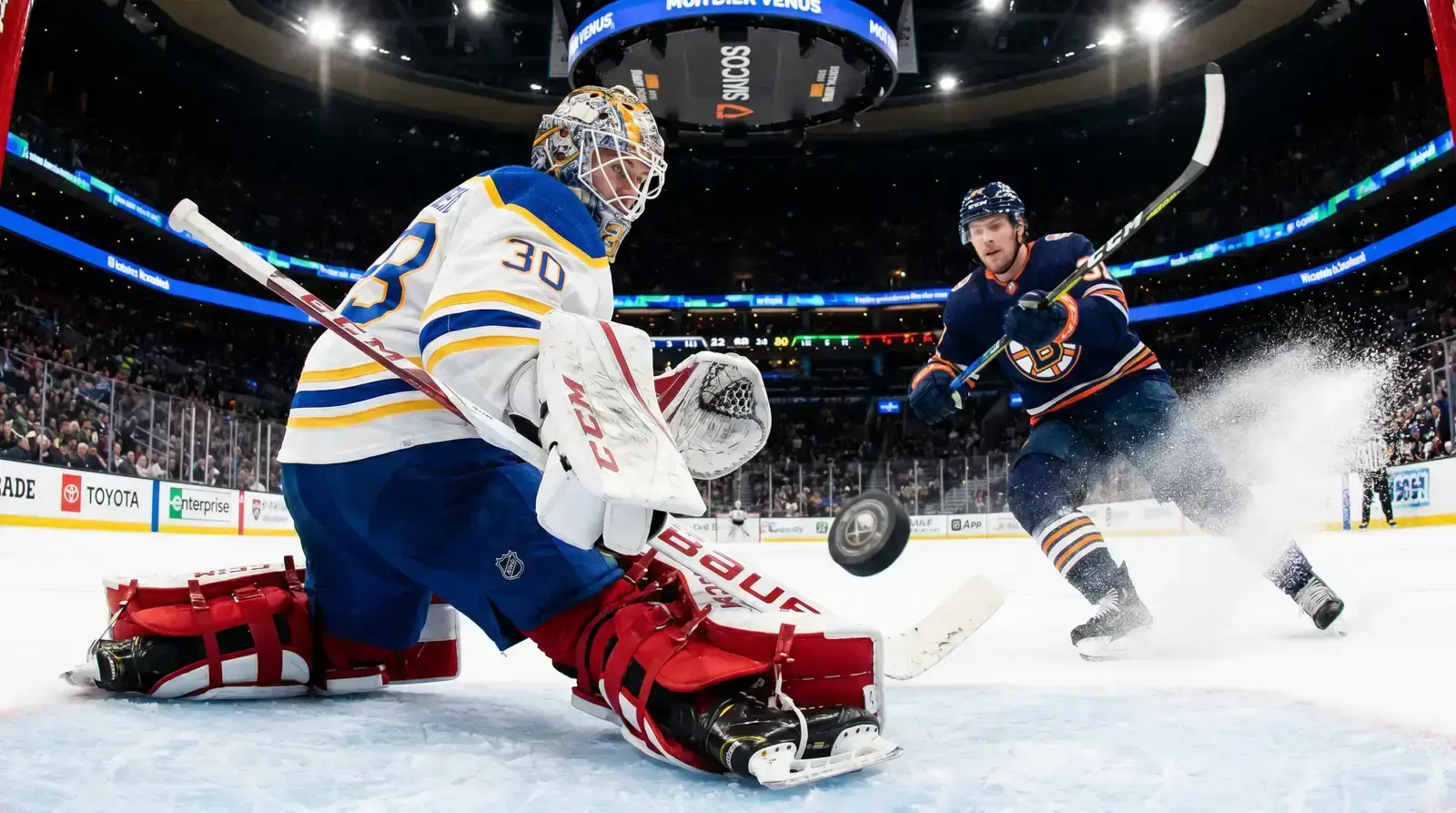
Knowing what's on the board is step one. Knowing when each market offers value — that's where strategy begins.
Strategy Foundations: The Numbers Behind Every Smart NHL Bet
Here's a confession that might surprise you: the single most profitable adjustment I've ever made to my NHL betting wasn't learning a new metric or discovering a secret model. It was tracking home-ice advantage with discipline instead of intuition. For years, I "knew" home teams won more often. I had no idea how much more often, or how dramatically that edge shifted depending on whether the home side was favoured or undervalued.
Home teams in the NHL won 56.6% of games during the 2024-25 season, compared to 43.4% for visitors. That 13.2
percentage-point gap is one of the most persistent edges in professional sport — wider than the Premier
League, tighter than the NBA, and remarkably stable year over year.

On the moneyline specifically, home teams converted at 54.2%. Those numbers look modest until you examine where the market misprice sits.
Home Win Rate
56.6% overall, 54.2% on the moneyline (2024-25)
Underdog Win Rate
39.1% outright — second highest in North American pro sport
Puck Line Cover Rate
Underdogs covered +1.5 in approximately 60% of games
The real story is in the intersection: home underdogs. When a team plays at home but is priced as the underdog, they won 44.4% of games on the moneyline — better than their implied odds typically suggest. Against the spread, home underdogs covered in 63.9% of cases, while home favourites managed only 41.8%. That gap is enormous, and it persists because the betting public gravitates toward favourites regardless of context. Casual money flows to the bigger name, the higher seed, the team with the flashier forwards. The market overprices these teams at home and underprices the scrappy host.
Home Favourites ATS
Covered the puck line in 41.8% of games. The public backs them heavily, inflating the price and shrinking the value. Favourites must win by two or more goals to cover -1.5 — a tall ask in a league where one-goal games account for nearly half of all results.
Home Underdogs ATS
Covered in 63.9% of games. The market undervalues them because "underdog" sounds risky. In reality, they only need to avoid a two-goal loss. Combined with home-ice energy and last change advantage, this is the most reliably mispriced spot in the NHL.
I'm not suggesting you blindly bet every home underdog. Context still matters — goaltender status, schedule position, divisional rivalry dynamics. But as a starting filter, "home team, underdog price, confirmed starter in net" has been the backbone of my NHL approach for years. The full strategic framework, including entry conditions and staking discipline, is laid out in my guide on building a repeatable NHL betting edge.
One more foundational point: hockey rewards patience. The 82-game regular season (expanding to 84 from 2026-27) generates a large sample, which means short-term variance is brutal but long-term trends are reliable. A 55% win rate on the moneyline at average odds of 2.10 produces meaningful profit over 200 bets. The mistake is expecting that 55% to show up in your first twenty wagers. It won't. Strategy isn't about avoiding losing streaks — it's about surviving them.

The Goaltender Edge: Why One Position Controls the Entire Market
No other major sport concentrates so much outcome variance in a single player. A Premier League goalkeeper faces perhaps four shots on target per match; an NHL goaltender faces thirty or more. The difference between a league-average netminder and an elite one isn't marginal — it's the difference between losing money and making it. I track goaltender data before I look at anything else on game day, and I've structured my entire workflow around that priority.
The 2025-26 season has sharpened this point further. The league-wide save percentage has dropped to 89.6% — below 90% for the first time since the 1993-94 campaign. That's thirty-plus years of history broken in a single season, and it rewrites the benchmarks every bettor should use. The old mental model of ".910 is average, .920 is good" needs updating. In the current environment, a .910 save percentage is above average, and anything at .920 or higher represents genuinely elite performance. Jesper Wallstedt leads the league at .936, a number so far above the pack that backing his starts becomes a near-automatic filter in my model.

League Average SV% (2025-26)
89.6% — lowest since 1993-94
Above Average Threshold
.910 — now meaningfully better than the pack
Elite Threshold
.920+ — only a handful of starters reach this level
Season Leader
Jesper Wallstedt at .936
Why does this matter for your bets? Because bookmaker lines are built on expected goals and team strength, not on the specific goaltender's performance in his last ten starts. When a team's backup — sitting at .895 for the season — draws the start instead of the number-one who posts .918, the moneyline often doesn't move enough to reflect that swing. I've tracked these discrepancies for five consecutive seasons, and the gap between "line with starter confirmed" and "line at open before goalie announcement" is where some of my highest-confidence plays originate.
NHL Commissioner Gary Bettman has been unequivocal about the sport's competitive integrity, maintaining that the nature of hockey itself — its speed, its complexity, its dependence on split-second decisions by twenty skaters and two goalies — makes it resistant to the kind of manipulation that haunts other sports. That confidence isn't just rhetoric: it's backed by real-time monitoring systems and multi-layered integrity agreements with licensed sportsbooks. For bettors, the implication is clear: the outcomes you're analysing are genuine, and the goaltender data you build your model on reflects honest competition.
The practical takeaway is straightforward. Before you evaluate matchups, totals, or prop markets, confirm who's starting in net. Services like Daily Faceoff publish projected starters each morning, and official confirmation typically arrives during the pre-game warm-up. If you've placed a bet and the goalie changes after your wager, most UK bookmakers will honour the original line — but the expected value of that bet may have shifted dramatically. My detailed breakdown of GSAx, high-danger save percentage, and the goaltender-confirmation workflow is in the dedicated goalie stats for betting article, which I'd recommend reading before you place a single puck-related wager.
The goaltender is the gatekeeper of value. But finding value also means knowing where to place your bets — and in the UK, that landscape has its own rules.
The UK Bookmaker Landscape for NHL Betting
A few years ago, I tried to bet on an NHL overtime result through a well-known UK betting app and couldn't find the market. It wasn't hidden — it simply didn't exist. The bookmaker offered moneyline, puck line, and match totals, and that was it. No period lines, no player props, no alternative puck lines. I've watched this change gradually, but the truth remains: NHL coverage at UK bookmakers is inconsistent, and choosing the wrong operator for hockey means leaving markets — and value — on the table.
The UK gambling industry generated GBP 16.8 billion in gross gambling yield in the year to March 2025, a 7.3% year-on-year rise driven largely by online growth. Within that figure, online gambling surged 13.1% to GBP 7.8 billion, reflecting a continuing shift from high-street shops to mobile and desktop platforms. For NHL bettors, this migration is positive: online platforms can offer deeper market coverage than a physical shop ever could, and the competitive pressure between operators pushes odds margins tighter on popular North American sports.

UKGC licensing — every bookmaker legally operating in the UK holds a licence from the UK Gambling Commission. Before depositing a penny, verify the operator's licence status on the UKGC public register. Unlicensed operators offer zero consumer protection: no dispute resolution, no self-exclusion integration with GamStop, and no guarantee your funds are ring-fenced. The country currently hosts 8,148 licensed gambling premises, including 5,669 bookmaker shops — but the operators you're most likely to use for NHL wagering are remote-licensed online platforms.
What should you look for in an NHL-capable UK bookmaker? Three things matter more than welcome bonuses: market depth, odds competitiveness, and live-betting functionality. Market depth means the operator offers puck lines, period totals, player props, and alternative lines — not just the moneyline and match total. Odds competitiveness means their NHL margins don't balloon to 8-10% the way they do at some operators who clearly treat hockey as an afterthought. And live-betting functionality means real-time markets that update during play, with a cash-out option that doesn't penalise you with absurd spreads.
The number of physical bookmaker shops in the UK has dropped to 5,825 — the eleventh consecutive year of decline. Meanwhile, the online sector keeps expanding. If you're betting on NHL games at 2:00 AM UK time, you're doing it on your phone, not at a shop counter. Choosing an operator with a strong mobile app and reliable live-streaming integration for North American sports isn't a luxury — it's a practical necessity.
I deliberately avoid ranking specific operators in this guide. The UK market is competitive, promotions change monthly, and what works for one bettor's preferences — early payout specials, accumulator insurance, odds boosts on ice hockey — may not suit another. What I will say is that the criteria above should be non-negotiable, and I've organised a full evaluation framework in the best NHL betting sites in the UK article, built around those exact principles. Use it as a checklist before you commit to any platform.
Advanced Analytics as a Betting Tool: From Data to Decision
I remember the exact moment analytics changed my NHL betting. It was February 2021, and I'd been backing a Western Conference team on a four-game winning streak. Their record looked brilliant, their goals-for numbers were climbing, and the moneyline kept shortening. Then I pulled up their Corsi data: 44.3% at five-on-five. They were being outshot, outchanced, and outplayed at even strength — the wins were built on an unsustainable shooting percentage and a goaltender standing on his head. I flipped my position, started fading them, and the correction arrived within two weeks. That's the power of looking beneath the scoreboard.

Corsi — the total number of shot attempts (goals, shots on goal, missed shots, and blocked shots) at even strength. Expressed as a percentage (Corsi For %), it measures possession and territorial control. A team above 52% CF% is generally dominating play; below 48% is a warning sign regardless of recent results.
Expected Goals (xG) — a model that assigns a scoring probability to every shot based on location, shot type, preceding events, and other variables. A team with an xG of 3.1 that scores 2 goals is underperforming; a team with an xG of 1.8 that scores 3 is riding luck. Over time, actual goals converge toward expected goals — and the gap between the two is your betting edge.
Fenwick — similar to Corsi but excludes blocked shots. Some analysts prefer Fenwick because blocked shots can indicate a deliberate defensive structure rather than poor possession. In practice, Corsi and Fenwick correlate closely, but Fenwick can be a cleaner signal for teams that play shot-blocking systems.
The mistake most bettors make with advanced analytics isn't ignorance — it's application. Plenty of people know what Corsi is. Very few have a workflow that converts a Corsi differential into a wagering decision. Here's a condensed version of mine.
From raw data to a betting decision: a worked example
Step 1 — Pull the data: I check five-on-five Corsi For % and xG differential for both teams over their last fifteen games. I use a rolling window, not season-long aggregates, because a team in November plays differently from that same team in March. Free sources for this data exist and I list them in the analytics deep-dive.
Step 2 — Filter for context: Is either team on the second night of a back-to-back? Has either team's starting goaltender changed? Are there significant injuries to top-six forwards or top-four defencemen? Each of these factors can distort the underlying data enough to invalidate the signal.
Step 3 — Compare to the line: If my data suggests Team A's true win probability is 58% and the bookmaker's implied probability (from the decimal odds) sits at 50%, I have an 8-point edge. That's a bet. If the gap is less than 3%, I pass — the margin is too thin to overcome the bookmaker's built-in vig.
Step 4 — Size and record: I stake a flat unit (more on this in the bankroll section) and log the bet with the closing line for later review. Over time, this log tells me whether my model is actually beating the market or just getting lucky.
NHL executive Keith Wachtel captured the broader trend well when he noted that the betting handle across sports is growing and that a rising tide is lifting all boats. For analytics-driven bettors, that growth means more data, more liquidity, and more opportunities to exploit soft lines — particularly in the NHL, where the totals market (centred around that persistent 6.5-goal line) and overs hitting at 52.9% this season create a fertile ground for xG-based approaches.
If you want the full pipeline — data sources, filtering logic, and model-to-wager conversion — I've built it out in my NHL advanced analytics for betting guide. What matters here is the principle: analytics aren't a crystal ball. They're a filter. You feed in every available game, and the filter spits out only the ones where the data and the price disagree enough to justify a bet.
UK Regulation and Responsible Play: What the Law Expects from You and Your Bookmaker
I've lost track of the number of NHL betting guides I've read that skip regulation entirely, as if the rules governing your account, your deposits, and your self-exclusion rights are somehow less important than whether the over is 6 or 6.5. They're not. If you bet on hockey in the UK, you operate inside one of the most tightly regulated gambling environments in the world — and understanding that framework protects both your bankroll and your wellbeing.
The UK Gambling Commission's most recent data puts problem gambling prevalence at 2.7% of adults on the PGSI
8+ scale, statistically stable compared to the prior year. Among men, the figure is higher, and among 18-24
year-olds it reaches approximately 10%. These aren't abstract numbers. If you're in your early twenties,
statistically one in ten of your peers who gamble is already experiencing harm. Tim Miller, the UKGC's
Executive Director, has been direct on this point, acknowledging that a group of vulnerable customers is not
currently being identified by existing approaches and that the status quo cannot hold.

The Commission is actively tightening its enforcement net — issuing over 740 cease-and-desist notices to unlicensed operators in the past year alone and reporting nearly 398,000 illegal URLs to search engines.
GamStop and the cross-product ban — GamStop is the UK's free self-exclusion scheme covering all UKGC-licensed online operators. Once you register, every participating bookmaker must block your account for your chosen exclusion period (six months, one year, or five years). Separately, since 19 December 2025, cross-product promotional incentives are banned in the UK. This means a bookmaker can no longer offer you "bet GBP 10 on NHL, get 20 free casino spins." Wagering requirements on bonuses are now capped at 10x the bonus amount. Both changes are designed to limit the bleed between sports betting and higher-risk casino products.
Do
- Set a deposit limit before your first NHL bet. Every UKGC-licensed bookmaker is required to offer daily, weekly, and monthly limits.
- Track your net position monthly — total staked minus total returned. A spreadsheet takes five minutes to build and prevents the "I'm roughly break-even" delusion.
- Use the reality-check timers built into every licensed platform. A nudge after 60 minutes of live betting is a small friction that prevents large losses.
- Know how to access GamStop before you need it. Registering takes minutes and covers all UKGC-licensed online operators simultaneously.
Don't
- Chase losses by increasing stake sizes after a bad night. The NHL season is 82 games long — one Tuesday in January is not a crisis.
- Bet on NHL games while simultaneously playing casino products. The cross-product ban exists for a reason: the behavioural crossover between sports betting and slot play amplifies risk.
- Ignore withdrawal friction. If a bookmaker makes it easy to deposit and difficult to withdraw, that's a design choice, not an accident. Move your bankroll to a platform with symmetric processes.
- Treat bonuses as free money. Wagering requirements, market restrictions, and time limits mean most bonuses return less than face value. Factor the real expected value before opting in.
Responsible gambling is not a section I tack on for compliance reasons. It's embedded in the process because discipline and self-awareness are the same skills that make you a better bettor. If you're reading this guide to find an edge in NHL markets, the single largest edge you can build is the ability to walk away from a session when the data isn't there — or when you are not in the right headspace to make rational decisions.
The 2025-26 Season in Context: Trends That Shape Your Bets Right Now
Every NHL season has a personality. Some are defined by dominant goaltending, others by a rule change or a generational talent hitting peak form. The 2025-26 season will be remembered for two things: the collapse of save percentages and the shadow of a labour dispute. Both have direct consequences for how you should be wagering.
I've already flagged the save-percentage decline above, but it's worth sitting with the magnitude. A league-wide 89.6% save rate isn't just a statistical footnote — it means approximately one extra goal per game compared to the league's historical .908 baseline. For totals bettors, this is the most significant scoring-environment shift in decades. Lines set at 6.5 that might have been coin flips three seasons ago are now leaning over. If your model still uses .908 as a baseline for goaltender evaluation, you're pricing games wrong.

Colorado won the Presidents' Trophy this season, and Connor McDavid claimed the scoring title once again. Neither of those outcomes surprised the futures market, but the journey to get there contained dozens of exploitable spots — mid-season slumps where the price on Colorado drifted to generous levels, or stretches where McDavid's team underperformed their xG and the moneyline overcompensated. Futures aren't just pre-season bets. They're a rolling market that reprices throughout the year, and the sharpest plays often come in January and February when the public has lost interest but the data is dense enough to model accurately.
The 2025-26 season is the last with an 82-game schedule. Starting in 2026-27, the NHL expands to 84 regular-season games. Two extra games per team means more back-to-backs, more schedule-spot opportunities, and a larger sample for in-season analytics. If you're building a strategy that relies on schedule fatigue — and you should be — the expanded calendar will only amplify that edge.
The other headline is labour uncertainty. The current collective bargaining agreement expires at the end of this season. If history is any guide — the NHL has locked out players in 1994-95, 2004-05 (losing the entire season), and 2012-13 — the possibility of a work stoppage in 2026-27 is non-trivial. For bettors, this creates two practical considerations. First, futures bets on the 2026-27 season carry CBA risk: if the season is shortened or cancelled, the settlement terms on those wagers vary by bookmaker and are rarely favourable. Second, the final weeks of the current season take on added intensity as players and teams push for results in what might be the last hockey they play for months. Playoff races tighten, motivation peaks, and the standard "rest versus compete" calculations shift.
The 2025-26 season's defining features for bettors: save percentages at a 30-year low demand recalibrated goaltender thresholds, the schedule expands from 82 to 84 games next season creating future opportunity, and CBA expiration makes 2026-27 futures a higher-risk proposition. Adjust your models, your staking, and your futures exposure accordingly.
The Pre-Bet Checklist: Seven Questions Before You Place a Wager
I run through a checklist before every NHL bet. Not metaphorically — I mean a literal list on my phone's notes app that I've refined over six seasons. The point isn't to slow me down; it's to prevent the kind of lazy, half-researched bets that erode a bankroll through a thousand small cuts. When I skip the checklist — and I have, usually during a busy slate of twelve-plus games — the results are measurably worse.

This isn't about making betting feel like homework. It's about making five minutes of structured thinking replace twenty minutes of regret. Each item below corresponds to a data point or a decision that has historically influenced outcomes in my tracked record. If you can't answer a question satisfactorily, that's not a reason to guess — it's a reason to skip the game and move on to one where your information is complete.
Run through this before every NHL wager
- Is the starting goaltender confirmed for both teams? If not, wait. A goalie switch can shift the expected outcome by two or more percentage points.
- Is either team on the second night of a back-to-back? If yes, check whether the starter from the previous night is resting. Back-to-back teams with a backup goaltender are a fundamentally different proposition.
- Has the line moved since opening? If it has moved toward the side you like, you may be chasing public money. If it has moved against you, check whether the shift is driven by sharp action or injury news.
- Does your analytics filter support this bet? Pull the five-on-five Corsi and xG differential for both teams over their last fifteen games. If the data contradicts your instinct, trust the data.
- Are there significant injuries beyond the goaltender? A missing top-pair defenceman or first-line centre affects shot generation and suppression in ways that basic standings don't capture.
- Is this game in a schedule-spot you've identified as exploitable? Trap games, three-in-four stretches, and cross-timezone travel all have documented effects on NHL outcomes.
- Does the stake fit your bankroll plan? A flat-unit system means every bet is the same size regardless of confidence. If you're tempted to go bigger on this one, that's a signal to double-check your reasoning, not your stake.
Print it, screenshot it, pin it to your desktop — whatever keeps it visible. The checklist doesn't guarantee winning bets. It guarantees that every bet you place has been through a minimum standard of analysis, which is more than most punters can say about most of their action.
Frequently Asked Questions About NHL Betting in the UK
What are the most profitable NHL betting markets for UK punters?
Historically, the puck line underdog (+1.5) has been the most consistently mispriced market in the NHL, covering in approximately 60% of games during recent seasons. Home underdogs on the moneyline also outperform their implied odds — winning 44.4% of games while typically being priced as if they'd win closer to 38-40%. Totals (over/under) markets offer value when you track the scoring environment and goaltender matchups closely, particularly in a high-scoring season like 2025-26. The key is not which market is "best" in the abstract but which market your data supports on a specific game. My approach prioritises moneyline for high-conviction spots and puck line underdogs as a volume play.
How does the puck line work in NHL betting?
The puck line is the NHL's point spread, fixed at 1.5 goals. Betting the favourite at -1.5 means they must win by two or more goals for your bet to land. Betting the underdog at +1.5 means they can lose by one goal and you still win. Crucially, puck line bets include overtime and shootout results — so a team that wins in a shootout is credited with a one-goal victory, which means the -1.5 favourite loses. The odds on each side of the puck line adjust to reflect the expected margin, making it a fundamentally different proposition from the moneyline even though both involve the same game.
Why is goaltender analysis the most important factor in NHL betting?
A starting goaltender faces thirty or more shots per game and directly controls the outcome more than any single player in football, basketball, or baseball. The difference between a .920 save percentage and a .900 save percentage over 30 shots is roughly 0.6 goals — enough to flip a one-goal game. In the 2025-26 season, with the league-wide save rate falling to 89.6%, the variance between starters and backups has become even more pronounced. NHL Commissioner Gary Bettman has emphasised that the league monitors every minute of every game, both in terms of play and betting-line movements, which ensures the goaltender data you're analysing reflects genuine competitive outcomes.
What schedule factors should UK NHL bettors watch before placing a wager?
Back-to-back games are the most well-known schedule factor: teams playing their second game in consecutive nights show measurably worse performance, particularly when travelling. But schedule awareness goes deeper. Three-games-in-four-nights stretches, cross-timezone road trips (Eastern team travelling to the Pacific division and vice versa), and "trap games" — where a strong team plays a weak opponent sandwiched between two marquee matchups — all create exploitable patterns. Home teams in the NHL already win 56.6% of the time; that edge widens when the visiting team is fatigued. The expanded 84-game schedule arriving in 2026-27 will only intensify these dynamics.
What advanced stats should I use for NHL betting?
Start with three metrics: Corsi For percentage (CF%), expected goals (xG), and save percentage. CF% measures possession by tracking all shot attempts at even strength — a team above 52% is generally controlling play. xG assigns a scoring probability to each shot, giving you a more accurate picture of who "should have" won a game than the actual score does. Save percentage tells you whether a goaltender is performing above or below the league baseline. Use a rolling fifteen-game window rather than season-long averages, filter for five-on-five play to strip out power-play noise, and compare your model's implied win probability to the bookmaker's price. If the gap exceeds 3%, you have a potential bet.
Is it legal to bet on NHL games in the UK?
Yes. Betting on NHL games is fully legal in the United Kingdom through any bookmaker holding a licence from the UK Gambling Commission. There are no restrictions on which sports or leagues UK-licensed operators can offer markets on, provided the events are legitimate and integrity-monitored. The NHL maintains official betting partnerships with major sportsbook operators and comprehensive integrity-monitoring systems. The UKGC regulates the operators, not the punters — your responsibility is to use a licensed platform, set responsible limits, and ensure you're of legal age (18+).
How do I manage my bankroll when betting on NHL long-term?
The flat-unit system is the most reliable approach I've used across eight seasons. Define your total bankroll — the amount you can afford to lose entirely without financial hardship. Divide it into units representing 1-2% of the total. Every bet, regardless of confidence level, is one unit. This prevents the catastrophic loss sequences that come from sizing up on "sure things" and keeps your exposure consistent across the 82-game season. Track every bet in a spreadsheet with columns for date, matchup, market, odds, stake, result, and closing line. Review monthly. If your ROI after 100+ bets is negative, the issue is your selection process, not your staking — and you'll have the data to diagnose exactly where. Problem gambling rates in the UK sit at 2.7% on the PGSI scale, and disciplined bankroll management is your first line of defence against drifting from recreational enjoyment into harmful behaviour.
