


I have a mate who builds 10-leg NHL accumulators every Saturday night. He has been doing it for three years. His lifetime ROI on those accumulators is negative 62%. He does not care — he views it as entertainment, and for 10 pounds a week, the dream of a four-figure payout keeps him engaged. I respect that choice, but it is not a betting strategy. The moment you start treating accumulators as a strategy rather than entertainment, the maths demands a different approach — fewer legs, smarter selection, and a hard ceiling on how much of your bankroll you expose to the most volatile bet type in sports.
Acca Maths and Reality
Keith Wachtel, the NHL’s president of business, has described the growing sportsbook handle as a rising tide lifting all boats. Part of that tide is accumulator volume — bookmakers love accas because the margin compounds with every leg, and the customer rarely notices. A single NHL moneyline bet might carry a 5% bookmaker margin. A five-leg accumulator on those same odds does not carry a 25% margin — it carries a compounding margin that can exceed 30%, because the overround multiplies leg by leg rather than adding linearly.

NHL underdogs won 39.1% of games in 2024-25. If you build a four-leg accumulator of underdog moneylines at average odds of 2.50, your combined odds are roughly 39.06. The true probability of all four underdogs winning is approximately 2.3%, which means the fair odds should be about 43.00. The bookmaker offers 39.06. That 10% gap between the fair price and the offered price is the house edge on your accumulator, and it is significantly higher than the edge on any single leg. The more legs you add, the wider the gap grows.
This does not mean accumulators are inherently unprofitable. It means they require a higher hit rate per leg to overcome the compounding margin. If each leg in your accumulator carries a genuine positive expected value, the accumulator inherits that edge — amplified by the multiplication. The problem is that most bettors do not have a positive-EV process for selecting legs. They pick favourites they like, add a total they fancy, and hope for the best. Hope is not a strategy.
Leg Selection Rules
My accumulator strategy is built on three strict rules that eliminate most of the legs a casual bettor would include.

Rule one: every leg must pass my individual-bet filter independently. If I would not bet the leg as a standalone wager, it does not enter the accumulator. This eliminates the “it’s only a small part of the acca” mentality that leads bettors to include low-confidence selections just to boost the combined odds. Each leg either has a positive expected value on its own or it stays out.
Rule two: I favour high-probability legs over high-odds legs. The underdog puck line at +1.5 covered approximately 60% of the time in 2024-25, and the odds on those legs typically sit between 1.45 and 1.60. Three such legs produce a combined price of roughly 3.05 to 4.10 — modest by acca standards, but the hit rate is vastly higher than a three-leg moneyline underdog parlay. I build what I call “grinder accas” — two or three legs, each with a 55-60% hit rate, producing combined odds in the 3.00 to 5.00 range. The payouts are not glamorous, but the win frequency keeps the bankroll healthy.
Rule three: I never combine positively correlated legs from the same game in an accumulator. That is what same game parlays are for, and they carry their own correlation penalties. My accumulators use legs from different games where the outcomes are genuinely independent. Independence means the combined probability of all legs winning is the simple product of each individual probability — no hidden correlations inflate my risk without my knowledge.

Small vs Large Accas
The sweet spot for NHL accumulators is two to three legs. At two legs, your combined win probability for grinder-style selections sits around 30-36%, which is manageable and sustainable. At three legs, it drops to 18-22%, which is still workable if each leg carries genuine value. At four legs, the probability falls below 15%, and the variance becomes severe enough that even a skilled bettor can go months without a winner.
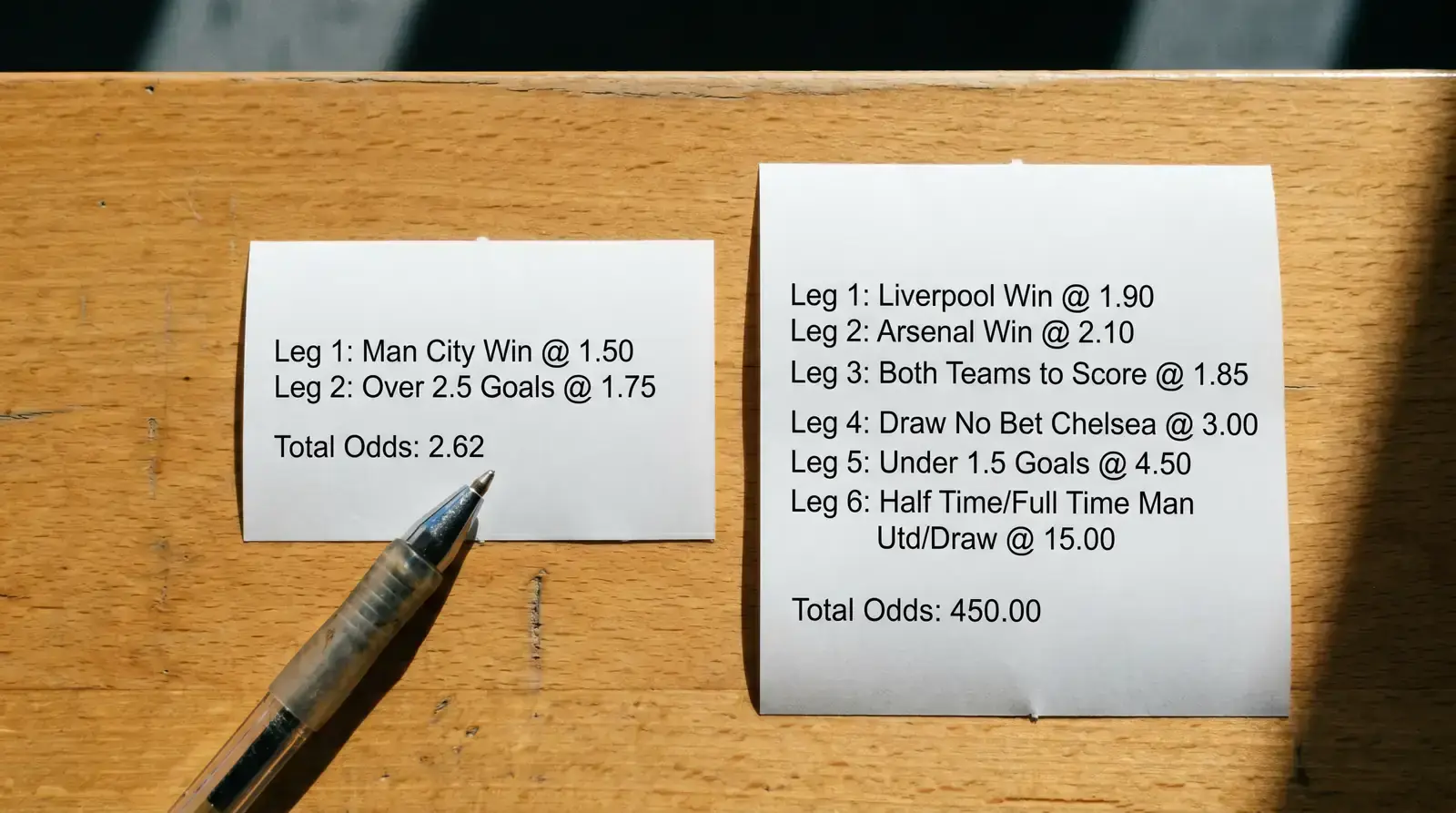
I build a maximum of two accumulators per week during the NHL regular season, each at half-unit stakes. That allocation limits my acca exposure to roughly 5% of my weekly NHL budget — the same cap I apply to same game parlays. If both accumulators lose, the damage is contained. If one hits, it typically produces a 2x to 4x return on the combined stake, which is a meaningful boost without being a bankroll-defining event.
Large accumulators — five legs or more — are entertainment products. The bookmaker’s compounding margin makes long-term profitability nearly impossible unless every single leg carries substantial positive expected value, which is an unrealistic standard for any bettor to maintain across five or more independent selections. I include one large acca per month as a 0.25-unit fun bet, and I do not track its results in my serious ROI calculations. If it hits, wonderful. If it does not, it has not dented my bankroll or distorted my discipline.
When Not to Build an Acca
Some nights the schedule does not produce enough qualifying legs. If only one game on the board passes my individual-bet filter, I bet that game as a single and skip the accumulator entirely. The worst habit I see among acca bettors is forcing legs into the slip just to have an accumulator running — adding a game they have not analysed, a total they are not confident about, or a favourite at short odds just to have a third leg. Every forced leg lowers the expected value of the entire accumulator and transforms what should be a disciplined compound bet into a lottery ticket with a negative edge.

The discipline is simple: build the acca around the legs, not the legs around the acca. Start with your best individual plays for the night, and only combine them if you have two or three that independently clear your quality threshold. If you have one strong play and two marginal ones, bet the strong one as a single and leave the marginals alone. The accumulator format amplifies whatever goes into it — amplified edge produces profit, amplified mediocrity produces losses.
