


Stanley Cup futures are the most emotionally charged market in NHL betting. Picking a champion feels like a statement of identity — “this is my team, this is my prediction, and I am willing to wait eight months for the payoff.” That emotional investment is exactly why the market is exploitable. The public overloads on popular teams, which depresses their odds below fair value, and neglects dark horses that offer genuine returns. I treat the Cup outright not as a prediction but as a price-discovery exercise: where is the market wrong, and by how much?
How Cup Odds Form
The Stanley Cup market opens in late June or early July, immediately after the current champion is crowned. At that point, the bookmaker’s pricing is based on last season’s performance, off-season trades, draft picks, and public sentiment. Colorado won the Presidents’ Trophy in 2025-26 and entered the playoffs as the consensus favourite, which meant their Cup odds were short all season. But winning the regular season and winning the Cup are different things — the playoff format introduces a level of variance that regular-season dominance cannot override.

The CBA expires after the 2025-26 season, which adds an unusual wrinkle to the futures market for the upcoming 2026-27 campaign. Any labour dispute that delays or cancels part of the season would devastate futures bets placed before the resolution. I factored this into my approach last season by reducing my futures exposure and focusing more on within-season markets. Until the new CBA is settled, Stanley Cup futures carry an additional layer of risk that the odds do not fully reflect.

The schedule expansion from 82 to 84 games starting in 2026-27 will also affect Cup odds formation. A longer regular season gives consistent teams more runway to separate from the pack, which should make the playoff field more predictable and slightly compress odds on the top seeds. Conversely, the extra two games add fatigue, which could make early-round upsets more likely in the playoffs. How bookmakers weight these competing effects will determine where value sits in next season’s Cup market.
Value Windows
Timing is everything in the Stanley Cup futures market, and I have identified three windows where mispricing is most common.

The first window is opening odds in late June. The market overreacts to the team that just won the Cup, pricing them shorter than their true probability of repeating. It also underprices teams that had strong regular seasons but lost in the first or second round of the playoffs. Those teams are often written off by the public, but a first-round exit does not erase the underlying quality that produced 100-plus points in the regular season.
The second window is early November, after about 15 games. Teams that started slowly due to schedule difficulty, new coaching systems, or key injuries are priced as if their October struggles will define their season. In my experience, early-season records are largely noise — the teams that were genuinely good before the season remain good, and their odds at this point offer a significant discount to their true probability of contending.
The third window is the trade deadline in early March. Teams that make aggressive acquisitions signal their intent to compete, and the market responds by shortening their odds. But the market often over-adjusts — a single blockbuster trade can compress a team’s Cup odds by 30% in a day, even though one player rarely changes a team’s championship probability by more than 5-10%. The value at the deadline is on the teams that did not make a splash but quietly remained among the league’s best.
To exploit any of these windows, you need a method for converting odds into implied probability and comparing it to your own assessment. Decimal odds of 8.00 imply a 12.5% chance of winning the Cup. If your model — or even your informed judgement after reviewing the underlying metrics — gives that team a 17% chance, you have a 4.5 percentage point edge, which is enormous in a futures market. The discipline is straightforward: calculate the implied probability for every realistic contender, estimate your own probability, and only bet where the gap exceeds 3-4 percentage points. This turns Cup betting from a fan’s prediction game into a systematic search for mispriced outcomes. I keep a simple spreadsheet updated at each of those three windows, and in most seasons I find two or three teams where the gap is wide enough to justify a position.
UK Bookmaker Availability
Not every UK bookmaker offers Stanley Cup futures year-round. Some only post the market during the pre-season and then again after the All-Star break. Others keep it open continuously but with wide margins and limited selections. I maintain accounts at three operators specifically for NHL futures, and I check all three before placing any futures wager because the price discrepancy on Cup outrights between UK bookmakers can exceed 3.00 in decimal odds for the same team.

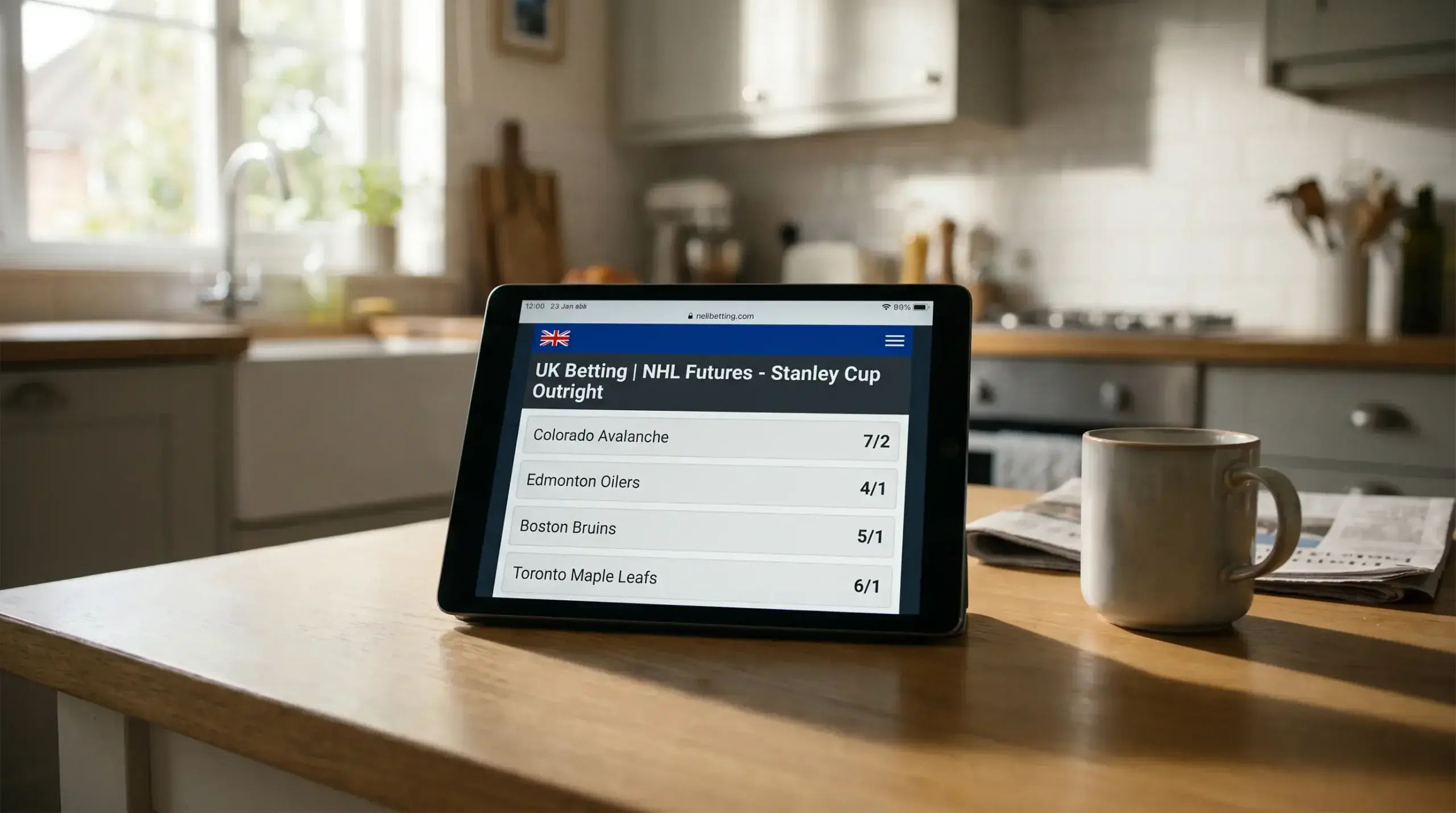
The reason for that discrepancy is simple: UK bookmakers allocate less analytical resource to NHL futures than to Premier League or Champions League markets. Their pricing is cruder, their margin is wider, and the line does not move as efficiently in response to new information. For a bettor willing to do the analytical work, this represents a structural advantage. You are operating in a market where your competition — the other bettors — is less informed and the bookmaker’s model is less precise. That combination is as close to a soft market as you will find in modern sports betting.
One practical note: when placing large futures bets with UK bookmakers, be aware of maximum payout limits. Some operators cap the payout on any single bet at a figure that makes high-odds futures impractical. If you back a team at 40.00 and the max payout is 250,000 pounds, your effective maximum stake is 6,250 pounds — which is fine for most recreational bettors but worth checking before you commit. The last thing you want is a winning ticket that pays less than you expected because of a payout cap buried in the terms.
