The NHL’s collective bargaining agreement expires after the 2025-26 season, and that single fact has been sitting in the back of my mind every time I consider a futures bet extending into the following campaign. Labour disputes have cancelled or shortened NHL seasons before — the entire 2004-05 season was wiped out, and the 2012-13 season was cut to 48 games. UK bettors who place long-dated futures without accounting for CBA risk are carrying exposure they have not priced in, and the market is not doing the work for them.
CBA Timeline and Stakes
The current CBA was negotiated during the pandemic and included provisions for revenue sharing, salary cap growth, and player movement rules. Its expiration means the league and the NHL Players’ Association must agree on a new deal or face a work stoppage. Gary Bettman, the league’s commissioner, has publicly framed the NHL’s approach to integrity and trust, stating that the agreement with the CFTC enhances the comprehensive integrity monitoring systems already in place and is fundamental to the trust fans and partners place in the game. That language about trust and partnership extends to the labour relationship — both sides have an incentive to avoid a lockout, but incentives and outcomes do not always align.

The schedule expansion from 82 to 84 games in 2026-27 was agreed as part of the framework for the next era. That expansion signals that both sides anticipate a deal getting done — you do not negotiate an expanded schedule if you expect a lockout. But schedule expansion also means higher revenue expectations, which raises the stakes for how that revenue is divided. The salary cap, the escrow mechanism, and the players’ share of hockey-related revenue are all on the table.
For bettors, the key date is not the CBA expiration itself but the deadline for either side to trigger a work stoppage. If negotiations extend into September 2026 without a deal, training camps could be delayed. If they extend into October, regular-season games could be cancelled. The worst-case scenario — a prolonged lockout — would void any futures bets that require a full season to settle. Most UK bookmakers include a clause in their terms and conditions that addresses shortened seasons or cancellations, but those clauses vary and few bettors read them before placing a 50-pound Cup future.
Impact on Futures Markets
Colorado won the Presidents’ Trophy in 2025-26 and Connor McDavid was the league’s leading scorer. Those facts will anchor the early pricing for 2026-27 Cup futures when they open in late June or July. But the CBA uncertainty introduces a risk premium that the market handles inconsistently.
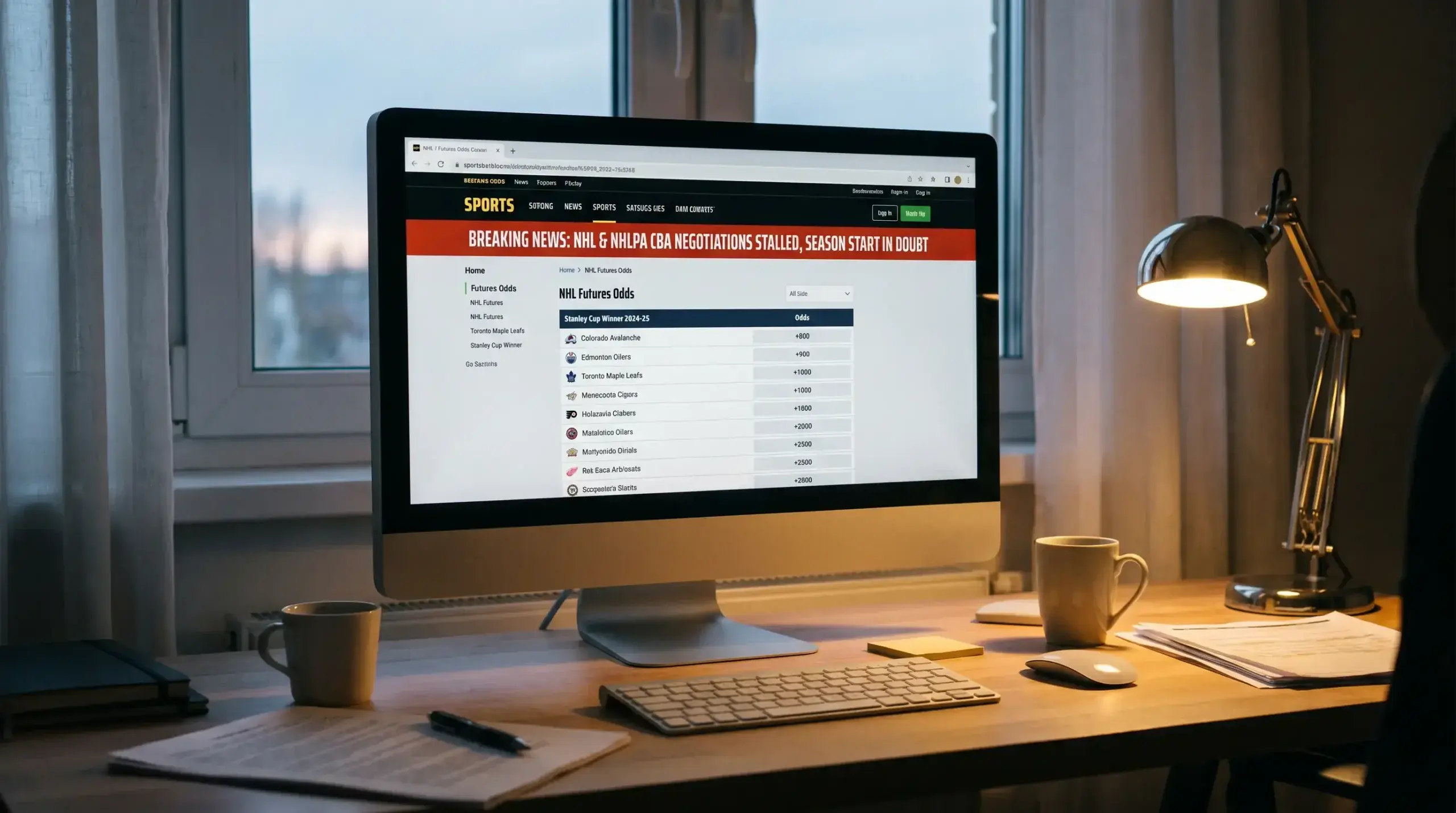
Some bookmakers will delay posting 2026-27 futures until the CBA situation clarifies, which removes the opportunity entirely. Others will post odds with wider margins to compensate for the uncertainty. A third group will post odds as if the season will proceed normally and let the terms and conditions handle any disruption. The third group is where value and risk coexist most dramatically — the odds look attractive because they are not discounted for CBA risk, but the risk is real and unhedged.
I have reduced my pre-season futures allocation for 2026-27 by half compared to a normal year. That reduction is not a prediction of a lockout — I genuinely expect a deal to get done — but it is a recognition that the expected value of a futures bet must be discounted by the probability of the bet being voided or settled unfavourably. A 15.00 Cup future that has a 10% chance of being voided due to a lockout has an effective expected payout of 13.50. That adjustment changes which bets clear my value threshold and which do not.
Hedging CBA Uncertainty
The cleanest hedge against CBA risk is to avoid long-dated bets entirely and focus on within-season markets once the 2026-27 campaign is confirmed. If the season starts on schedule in October, you can place futures bets at that point with the CBA risk eliminated, albeit at shorter odds than you would have gotten in July.

If you do place pre-season futures, keep the stakes small enough that a voided bet does not damage your bankroll. I treat CBA-exposed futures as lottery tickets rather than core positions — half-unit stakes maximum, spread across three or four teams to diversify the selection risk alongside the labour risk. The goal is to capture the price premium that exists because other bettors are either unaware of or indifferent to the CBA expiration, without overexposing myself to a scenario where the entire position is wiped out.
One more consideration: player movement during CBA negotiations can be unpredictable. If the deal includes changes to free-agency rules, salary cap structure, or revenue sharing, teams that looked like contenders under the old rules may be weakened under the new ones. That uncertainty means pre-CBA futures are priced off a roster landscape that could shift dramatically once the new deal is signed. I wait for the ink to dry before committing my full futures allocation, and I recommend every UK bettor do the same.
What the History Tells Us
The NHL has locked out its players three times in the modern era: 1994-95 (shortened to 48 games), 2004-05 (entire season cancelled), and 2012-13 (shortened to 48 games). In each case, the betting market was caught off guard. Futures bets were voided, season-win totals were adjusted retroactively, and bettors who had committed capital months in advance lost their stakes without a game being played. The lesson is not that a lockout is likely — the economic incentives favour a deal — but that the downside scenario, however improbable, is severe enough to justify caution in position sizing. Preparation costs nothing. A voided bankroll costs everything.