

The first time I opened an American NHL betting site, I thought the numbers were broken. A favourite at -180 and an underdog at +150 — what did that even mean? I had grown up with fractional odds on Premier League football and had only recently switched to decimals. American odds felt like a different language. It took me a frustrating afternoon of manual conversions before I could read all three formats fluently, and that afternoon has saved me thousands of pounds in the years since because understanding odds formats is not just a technical skill — it is the foundation of every value calculation you will ever make.
The Three Odds Formats
About 8% of adults in the UK placed a sports bet online or through an app in the past four weeks, and most of them will never need to think about odds formats beyond decimal. But NHL betting pulls you into an international market where American odds dominate the discussion — every US-based tipster, every analytics site, every line-movement tracker reports in American format. If you cannot convert on the fly, you are locked out of the sharpest information sources.
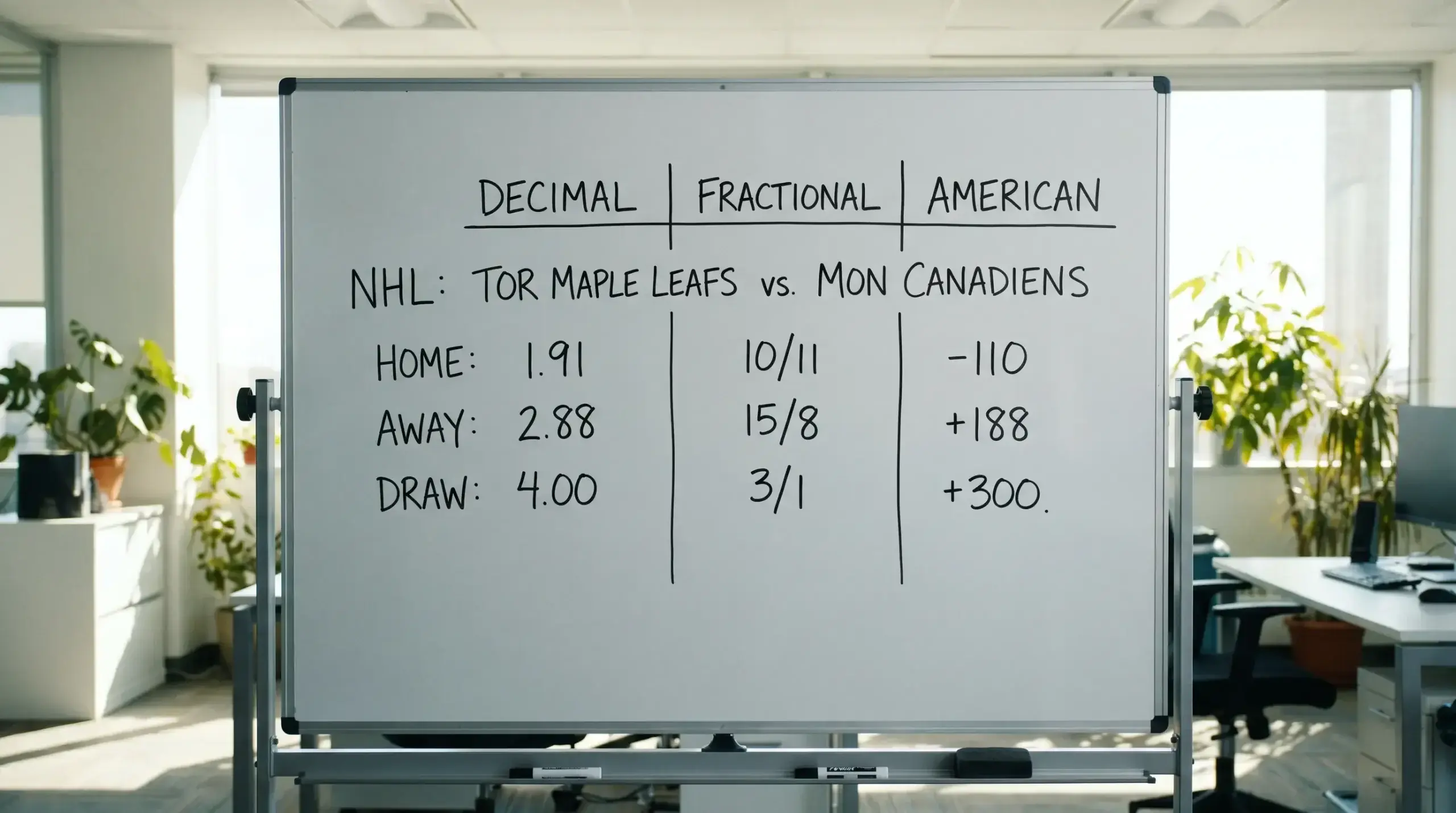
Decimal odds are what UK bookmakers display by default. The number represents your total return per pound staked, including the original stake. Odds of 2.50 mean a one-pound bet returns two pounds fifty — one pound fifty in profit plus your pound back. The beauty of decimals is simplicity: higher number equals bigger payout, and you can compare two bets at a glance without any mental gymnastics.
Fractional odds are the traditional British format — 6/4, 5/2, 11/10. The first number is your profit relative to the second number as your stake. Odds of 6/4 mean you win six pounds for every four pounds staked. Fractional odds are intuitive for horse racing bettors but cumbersome for NHL because hockey odds tend to land on awkward fractions that are hard to compare. Is 11/8 better than 6/5? You can work it out, but decimals give you the answer instantly: 2.375 versus 2.20.
American odds centre on a baseline of 100. A favourite is shown with a minus sign: -180 means you must stake 180 to win 100. An underdog gets a plus: +150 means a stake of 100 wins 150. Michael Dugher, head of the Betting and Gaming Council, has noted that problem gambling rates in the UK have fallen again — a result that should reassure bettors engaging responsibly with new markets. Part of responsible engagement is understanding what you are betting, and that starts with knowing what the odds actually mean before you commit a penny.
Calculating Implied Probability
Every set of odds implies a probability that the bookmaker assigns to the outcome. Extracting that implied probability is the single most important calculation in betting because it lets you compare the bookmaker’s assessment to your own.

For decimal odds, the formula is: 1 divided by the decimal odds, multiplied by 100. Odds of 2.50 give you 1 / 2.50 = 0.40, or 40%. That means the bookmaker prices this outcome at a 40% chance. If your analysis says the true probability is 45%, you have found a 5-percentage-point edge — a value bet.
For fractional odds, convert to decimal first: divide the first number by the second and add 1. So 6/4 becomes (6 / 4) + 1 = 2.50, and then apply the decimal formula. For American odds, the conversion depends on the sign. For a positive number like +150: 100 / (150 + 100) = 0.40, or 40%. For a negative number like -180: 180 / (180 + 100) = 0.643, or 64.3%.
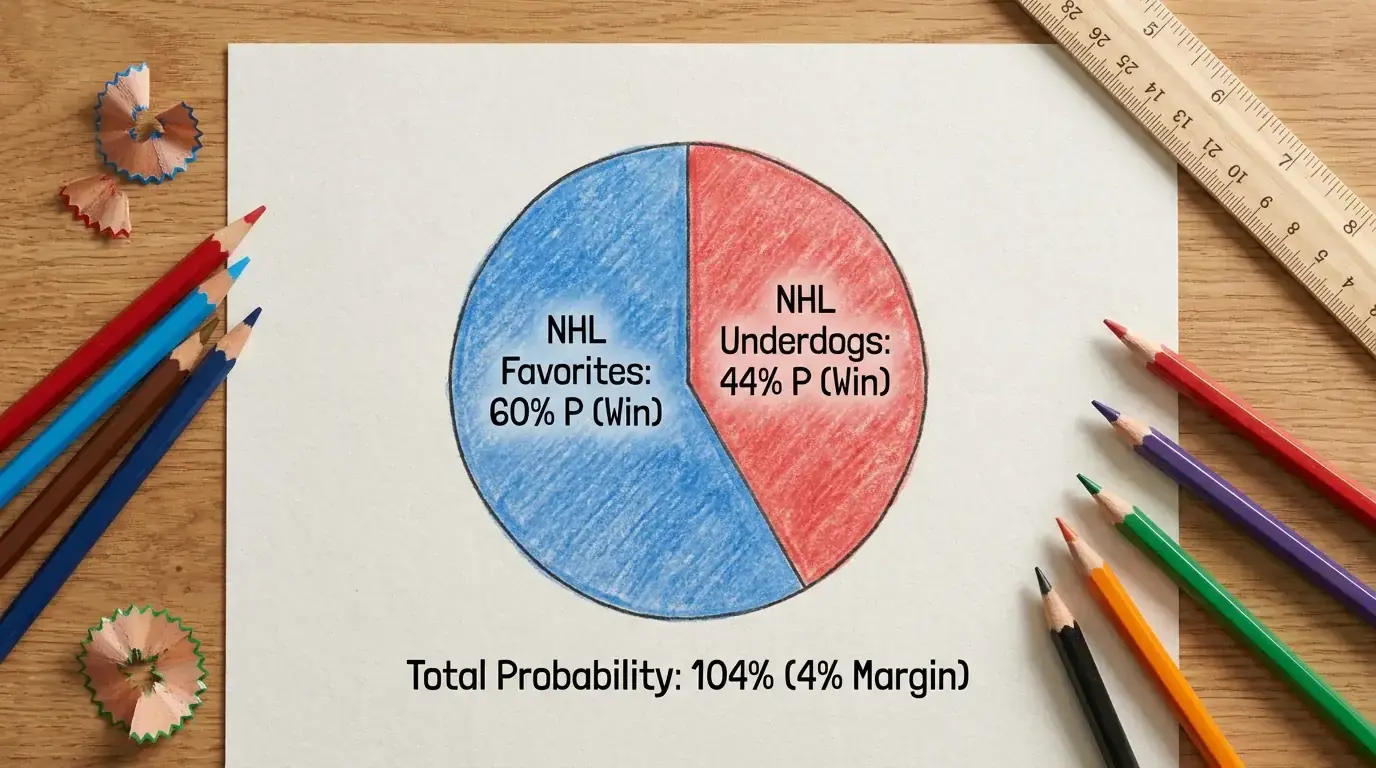
The sum of implied probabilities for all outcomes in a market will exceed 100% — that excess is the bookmaker’s margin, or overround. On a typical NHL moneyline, the overround sits between 4% and 8% depending on the operator and the match. Knowing the overround tells you how much you are paying in “tax” to the bookmaker. Lower overround means better value for the bettor. Comparing overrounds across UK bookmakers is a simple way to consistently get better prices without any analytical skill whatsoever.
Reading NHL Odds Boards
When you open an NHL market page at a UK bookmaker, you will typically see the moneyline, puck line, and total displayed side by side for each game. The moneyline shows a favourite with lower odds and an underdog with higher odds. The puck line shows -1.5 and +1.5 with their respective prices. The total shows over and under with the goal line — usually 6.5 — and the price on each side.

What trips up new NHL bettors is the density of information. A single game might have 40 or more markets listed below the headline numbers: period results, player props, alternative lines, correct score. My advice for anyone starting out: ignore everything except the moneyline and the total for your first month. Learn to read those two markets fluently, understand the implied probabilities, and compare prices across operators. Once that process feels automatic, expand into puck lines and props.
One practical tip: most UK bookmakers allow you to toggle between decimal and fractional display in your account settings. Switch to decimal permanently if you have not already. Every analytical resource, every value-calculation formula, and every odds-comparison tool works faster in decimal format. Fractional odds are a legacy of horse racing culture, and while there is nothing wrong with them, they add an unnecessary conversion step to your NHL betting workflow. Remove that friction and your decision-making speed improves immediately.
Putting Odds Literacy to Work
Understanding odds formats is the floor, not the ceiling. The ceiling is using that understanding to identify mispriced lines before the market corrects. Every morning during the NHL season, I pull up the same game across three UK operators and compare the decimal odds. A difference of 0.05 on a favourite might seem trivial, but over 200 bets at an average stake of ten pounds, that 0.05 translates to roughly one hundred pounds of additional profit — or loss, depending on which side of the difference you are on.

The bettors who treat odds as just a number — something they glance at before clicking “place bet” — are subsidising the bettors who treat odds as data. Every number tells you what the bookmaker thinks, and the gap between what they think and what you think is the entire game. Master the formats, automate the conversions in your head, and you will never again place a bet without knowing exactly what edge you are — or are not — getting.
