


I remember the first NHL spread bet I placed — a Colorado Avalanche puck line at -1.5, odds around 2.30 in decimal. They won 5-2, and I felt like a genius. Two nights later I backed the same team at -1.5, they won 3-2, and the bet was dead. That second loss taught me more about spread betting in hockey than any guide ever could: the puck line is not a prediction of dominance. It is a bet on margin, and margin in the NHL is brutally thin.
Unlike football or basketball, where point spreads shift from game to game, the NHL puck line almost always sits at 1.5 goals. That fixed number shapes everything — the odds attached to it, the situations where it delivers value, and the traps it sets for bettors who treat it like a bigger moneyline. Underdogs covered the puck line at +1.5 roughly 60% of the time during the 2024-25 season, which immediately tells you the market tilts toward the dog on this line. But the juice on those underdogs eats into your profit, and the favourite side at -1.5 is where the real decisions get interesting.
What Is the Puck Line
A couple of years into my betting career, I started explaining the puck line to mates by comparing it to a handicap in golf — except the handicap never changes. The puck line is the NHL’s version of a point spread, fixed at 1.5 goals. Back a favourite at -1.5, and they need to win by two or more. Take the underdog at +1.5, and they can lose by a single goal and your bet still lands.

The reason the line stays at 1.5 rather than shifting to 2.5 or 3.5 is simple: NHL scoring is low and tightly clustered. Most games are decided by one or two goals. A standard final score of 3-2 or 4-3 means one-goal margins dominate. Moving the spread to 2.5 would make the favourite side almost unplayable in terms of odds. Bookmakers compensate for the fixed spread by adjusting the price on each side instead. A heavy favourite like Edmonton at home might be -1.5 at 1.70, while the underdog sits at +1.5 around 2.15. A closer matchup pushes the favourite to -1.5 at 2.40 and the dog to +1.5 at 1.55.
For UK punters used to Asian handicap markets in football, the logic is familiar — but the fixed nature of 1.5 removes the variable spread and puts all the movement into the price. That is where value hides, and where careless bettors get caught paying too much juice on the underdog side.
Puck Line vs Moneyline
Every sharp NHL bettor I know asks the same question before locking a wager: does this spot favour the moneyline or the puck line? The answer depends on how confident you are in the margin of victory, not just who wins.
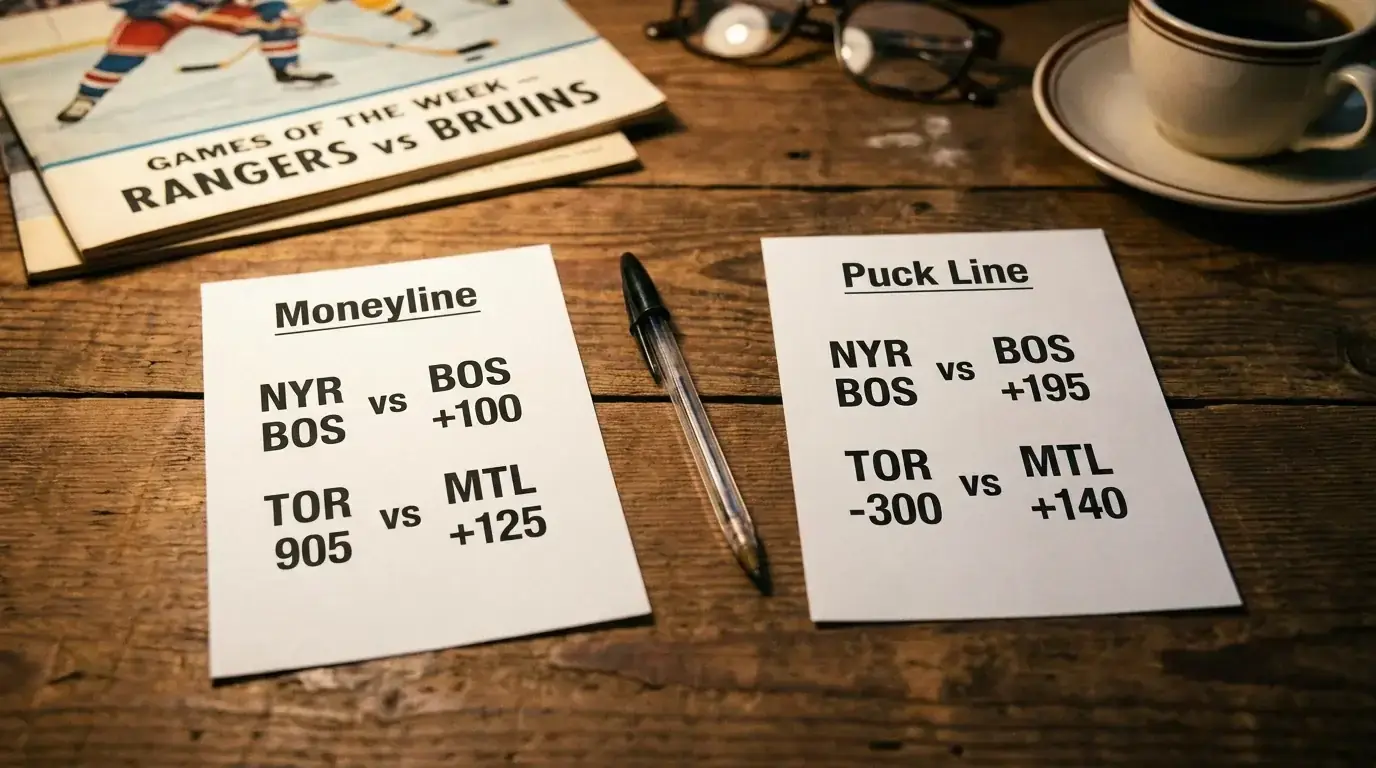
On the moneyline, you only need your team to win — overtime, shootout, regulation, does not matter. The price reflects that simplicity. A favourite at 1.45 on the moneyline might become 2.30 on the puck line at -1.5, which is a substantial jump in potential return. But in the 2024-25 season, home underdogs won outright 44.4% of the time — higher than their odds implied. That gap between implied probability and actual win rate is the core of moneyline value on the underdog side.
The puck line reverses the value proposition. Underdogs at +1.5 hit at about 60%, but the juice often prices you at 1.50 or below, compressing your edge. Where the puck line shines is on the favourite side: if you have identified a matchup where a strong home team faces a depleted opponent — backup goalie, second night of a back-to-back, long road trip — the -1.5 at boosted odds becomes a higher-variance, higher-reward play compared to laying short moneyline juice. I find the best puck line value on favourites priced between -160 and -200 on the moneyline, where the -1.5 puck line sits in that 2.00-2.40 sweet spot.
When to Bet the Puck Line
Not every game deserves a puck line wager. I have a short checklist I run before I even look at the number: is the favourite’s starting goaltender confirmed? Is the opponent on the second night of a back-to-back? Has the line moved toward the favourite since opening? If I cannot tick at least two of those three, I default to the moneyline or skip entirely.

The NHL’s betting handle keeps growing — Keith Wachtel, the league’s head of business, put it bluntly when he said the rising tide is lifting all boats for sportsbooks. More money flowing into NHL markets means tighter lines on the moneyline, which pushes value-seekers toward the puck line where the odds have more room to breathe. That shift matters for UK bettors because our bookmakers already bake in a wider margin on NHL compared to Premier League football. If the moneyline margin is already steep, the puck line can offer a better risk-reward profile on the favourite side.
Situational spots matter enormously. Games where a top team plays at home against a West Coast opponent travelling east for a weeknight fixture — those produce two-goal-plus margins at a higher rate. Playoff-race desperation in March and April is another trigger: teams chasing a wild card berth play with an intensity that blows out weaker opponents. I also watch for goaltending mismatches where one side is rolling out a backup with a save percentage below .900 against a team that generates high volumes of expected goals. Those are the nights the puck line favourite earns its keep.
The Reverse Puck Line
Most UK bookmakers now offer the reverse puck line — also called the alternative spread — where you take a favourite at -0.5 or an underdog at +2.5. The -0.5 line on the favourite is functionally identical to the moneyline but may be priced differently on some platforms due to how the book structures its markets. It is worth comparing both before placing.

The +2.5 underdog line is where things get genuinely useful. If I like an underdog’s defence and goaltending but do not trust them to win outright, +2.5 gives a massive cushion. The odds will be short — often 1.20 to 1.35 — but as a leg in a same game parlay or an accumulator anchor, it adds reliability without dead weight. Just remember: shootout results count for settlement in most puck line markets, but the shootout itself can only produce a one-goal margin (the winning goal). That means a game that goes to a shootout always settles as a one-goal result for spread purposes, which benefits the +1.5 underdog every single time.
One pattern I have noticed over the past three seasons is that the reverse puck line at +2.5 combined with a first-period under is a low-variance parlay structure. It will not produce explosive returns, but it grinds out small, consistent profits if you select your spots carefully — particularly in low-event matchups between defensive-minded teams.
Where the Puck Line Fits in Your Betting Toolkit
The puck line is not a market you hammer every night. It is a scalpel, not a sledgehammer. The fixed 1.5-goal spread means you are always operating on the knife-edge of one-goal games, which account for roughly a third of all NHL results. That volatility is the price of the boosted odds on the favourite side and the reason I only deploy it when the situational evidence stacks up.

What I have learned across eight years is that the bettors who lose money on puck lines treat them as a way to get better odds on favourites they already wanted. The bettors who profit treat them as a separate market with separate criteria. Start with the matchup, ask whether the margin matters more than the winner, and let the answer dictate which line you take. That discipline is the difference between a puck line being a tool and a trap.
