


I keep a printed NHL schedule on my desk from October through April, and by mid-season it looks like a war map — circles, crosses, and colour-coded highlights marking every exploitable spot I can find. Most bettors evaluate matchups by looking at who is playing whom. I evaluate when they are playing, where they just came from, and how much rest separates the games. The schedule is the most overlooked dataset in NHL betting, and it hands you edges that do not require a single advanced metric to exploit.
The 2025-26 season was the last to run on the 82-game format. Starting in 2026-27, the schedule expands to 84 games, which means even more compressed stretches, more travel, and more opportunities for bettors who understand how fatigue and scheduling create predictable performance drops.
Types of Schedule Spots
Not all schedule disadvantages are created equal. I classify them into four categories, each with a different magnitude of impact and a different betting approach.
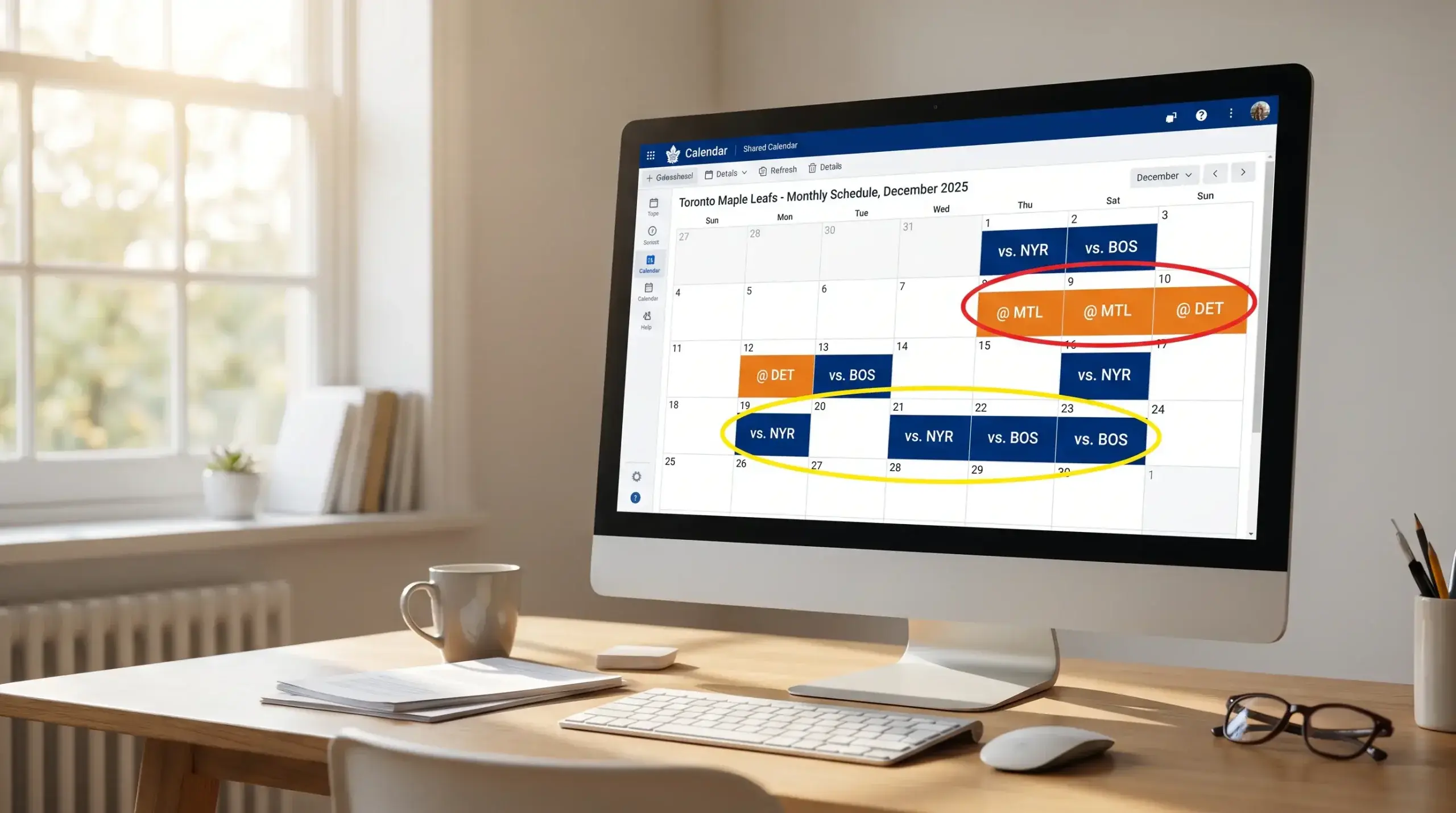
The classic back-to-back is the most widely discussed, but it is also the most efficiently priced because every bettor and every bookmaker knows it exists. The edge here has compressed over the past five seasons as the market has learned to adjust. Still, home teams won 56.6% of games overall in 2024-25, and that number drops measurably when the home team is on the second leg of a back-to-back — the market adjusts, but often not enough.
The trap game is subtler. A top team plays a marquee game — a rivalry match, a nationally televised Saturday contest — and then faces a bottom-feeder the following Tuesday. The public expects a blowout; the players deliver a flat, unfocused performance. I have tracked trap games for four seasons, and the favourite in a post-marquee spot against a non-contender covers the puck line at roughly 5% below their baseline rate. The edge is not enormous, but it is consistent and it compounds across a full season.
The travel grinder is my favourite category. A Western Conference team playing three road games in four nights across two or three time zones arrives at the final destination physically depleted. The schedule expansion to 84 games will increase these clusters because more games must be squeezed into the same October-to-April window, meaning road trips will lengthen and rest days between them will shrink. I target the third or fourth game of these extended road swings, particularly when the opponent is rested and playing at home.
The rest-day mismatch is the easiest to identify and one of the hardest for the bookmaker to price correctly. When one team has had three or more days off and the other played the previous night, the rested side holds a substantial advantage. These mismatches occur most frequently in the week after the All-Star break and around the trade deadline, when the schedule bunches games unevenly. I flag every rest-day mismatch of two-plus days at the start of each month and track the line movement to see whether the market catches up before game time.
Travel and Timezone Impact
The NHL is the most geographically dispersed major professional league in North America. A team can fly from Sunrise, Florida to Vancouver, British Columbia — a journey spanning three time zones and nearly 5,000 kilometres. That travel toll shows up in the data: home underdogs won 44.4% of their games in 2024-25, and that figure rises when the visiting favourite has crossed two or more time zones in the previous 48 hours.

Eastbound travel is worse than westbound for performance. This is not hockey folklore — it aligns with circadian research showing that adjusting to earlier time zones is physiologically harder than adjusting to later ones. A team flying from Los Angeles to New York loses three hours and arrives with their body clocks set to late afternoon when it is actually evening. The first game after an eastbound cross-country trip is the schedule spot I weight most heavily in my model.
I also track altitude. Denver’s arena sits above 1,600 metres, and visiting teams consistently underperform their baseline there compared to other road games. The effect is strongest on teams that flew in from sea-level cities on the same day, which eliminates any acclimatisation benefit. For totals betting, I add 0.2 expected goals to the over when a sea-level team plays in Denver without an overnight stay.
Three-in-Four and Five-in-Seven
Beyond back-to-backs, compressed stretches of three games in four nights or five games in seven nights create cumulative fatigue that the market underprices. The back-to-back within a three-in-four gets all the attention, but the third game — often played with one day of rest after two games in two nights — produces performance declines that are almost as severe as the back-to-back second leg itself.

Five-in-seven stretches are rarer but devastating. They typically occur during dense November and January scheduling, and teams facing them almost always split their goaltending workload across three or even four of the five games. The key betting play is on the fourth or fifth game, when both the skaters and the goaltenders are running on fumes. I target the total in these spots: the over hits at an elevated rate because tired defences give up more high-danger chances and fatigued goaltenders save at below their season average.
The discipline with schedule-spot betting is to verify that the market has not already priced in the disadvantage. I compare the opening line to the line at three hours before puck drop. If the line has moved significantly toward the rested side, the smart money has already acted and the remaining edge is slim. If the line is flat or has moved toward the fatigued side — sometimes driven by public money on the bigger brand — the schedule-spot edge remains intact and I act with confidence.
Building a Schedule-Spot Calendar
Every month during the season, I spend 30 minutes building a calendar of exploitable spots. I pull the full schedule from the NHL’s website, highlight every back-to-back, every three-in-four, every cross-timezone road trip, and every rest-day mismatch of two or more days. That calendar becomes my primary screening tool — I only analyse games that appear on it, which eliminates roughly 60% of the daily card and lets me focus my analytical effort where the structural edge is strongest. The bettors who try to handicap every game spread their attention too thin. The bettors who let the schedule filter their attention find value more consistently, with less work, and with a discipline that compounds across an 82-game — soon to be 84-game — season.